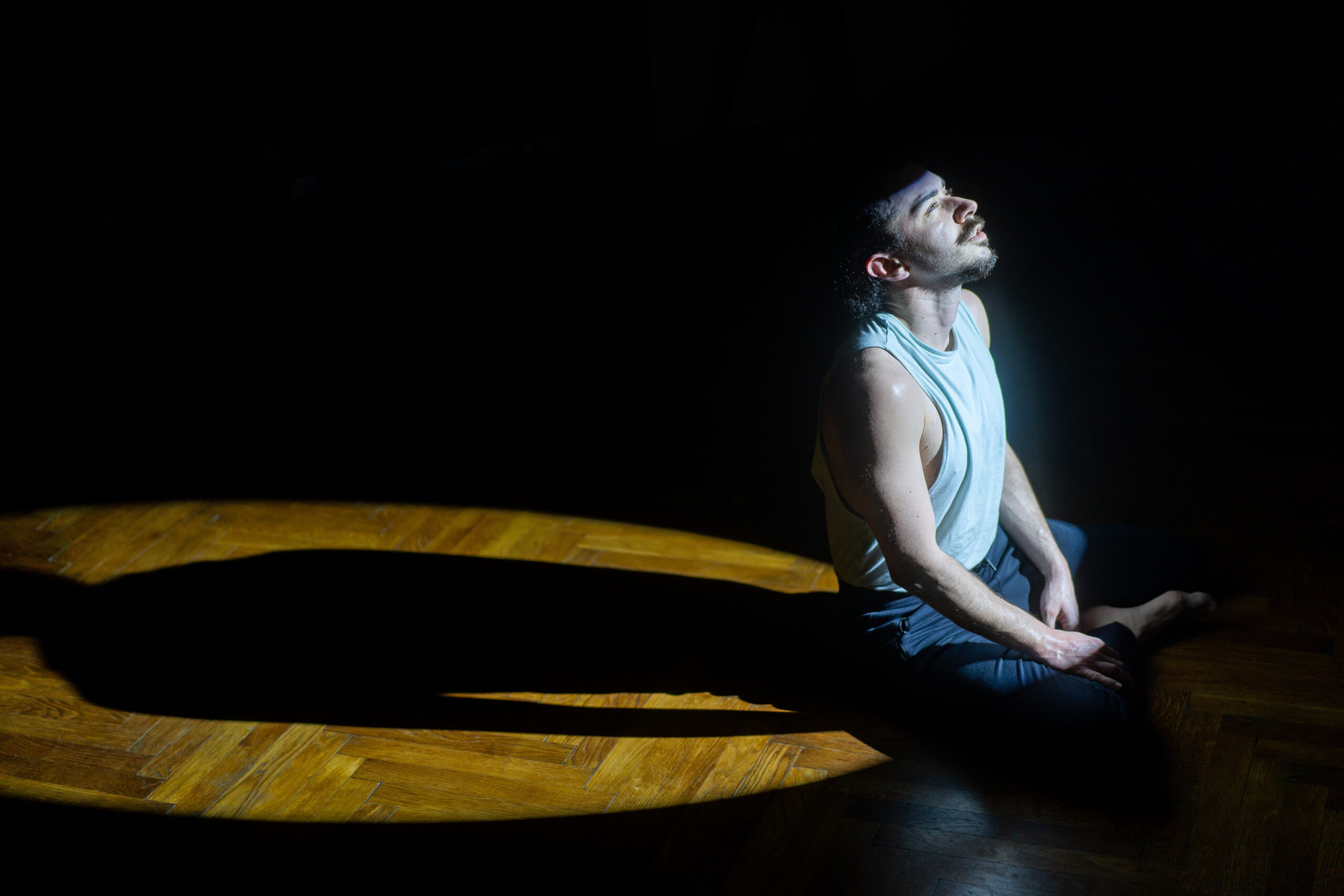
Before We Begin

Before We Begin

Project by director Jug Đorđević and playwright Tijana Grumić

Starring: Ema Muratović, Matija Stefanović i Aleksander Zain

Costume: Velimirka Damjanović

Choreographer and dancer: Aleksander Zain

Project Associates: Vasil Vid Pašanjski, Agata Đurić

Tech Associate: Nemanja Calić

Premiere: 11th March 2023 at the Heartefact House (season 2022/2023)

The focus of the play is the author’s dilemma of whether an artist has the right to speak about systemic, social, and individual forms of discrimination and stigmatization of marginalized groups in our society, even though the author does not belong to those groups. Through a broader thematic framework, the personal story of the main character is skillfully intertwined, which movingly portrays the question of their gender identity.

“The process of creating this play is specific and unconventional for several reasons. Besides the atypical performance space, the content, i.e. the text of this play, did not exist before the rehearsals began, but was created during the process itself, in collaboration with the performers. This approach required sensitivity to the topic that we decided to explore. During discussions about the project, before we even started working on it, Jug and I often debated whether we could, and how we could, address this issue, and what responsibility we had in that case. That debate eventually became one of the cornerstones of our play. Theatre has always been a space of encounter, dialogue, and exchange of opinions, and I believe that it is also a space for questioning and criticizing the reality in which we live, but also a space for dreaming of a better and more just reality, a better and more just society. Since theatre is precisely the space of our action, our reflection on the world, we wanted to use that space to hear those voices that we cannot normally hear on the stage.”

Tijana Grumić

“When Tijana and I received an invitation from Heartefact to work on our own project, it was an offer I didn’t have to think much about. Nowadays, it’s rare that someone calls you to work on your own project, and I believe every director wishes to try their hand at this form of authorship. The second thing is the fact that the thematic framework that deals with issues related to the LGBTQ+ community is an extremely inspiring topic when you have to deal with it in a patriarchal theatre (and social) system like ours in Serbia. The third thing is certainly the unconventional approach and departure from the framework of institutional theater, which Heartefact certainly represents. In the case of this project, we realized that we had to deal with it even before its formal start, that is, we had to reconsider our personal authorial positions and responsibilities towards the topic. If we want to deal with issues that polarize, to deal with questions of representation, artistic exploitation, and manipulation, we must ask what are the limits, if there are any at all, and when is the time, before we start, to sit down and have a collective conversation?”

Jug Đorđević

Festivals/guest performances

Pride Week in Novi Sad – Novi Sad, May 2023

There's more

Quiet Hours from Two to Six

One building. Two women. Three encounters. Four neighbors. And countless rules — written and unwritten. “Quiet hours from two to six” is more than a house rule – it is a principle by which one lives, survives, or gets by.

Art&Money

An impossible love story between art and capital – a play about loneliness, dependency, and the quiet cruelty of needing something you cannot live with, by Swedish author and director Freja Hallberg.

They Are All Gone

After more than four years of artistic research, our performance “They are all gone” examines the question of responsibility, forgetting and solidarity using a hybrid theatrical form. The author’s project of director Andrej Nosov was created based on the text by Doruntina Basha.

All The Good Barbies

The play follows a young, uncompromising woman who returns to her hometown just before her thirtieth birthday, unwilling to admit her own failure or the reasons for her return. However, through intense encounters with her family and friends, she is forced not only to confront that wound but also numerous scars from her childhood.

How I Learned to Drive

“How I Learned to Drive” by Paula Vogel, a text often referred to as the “Lolita” written from a female perspective – the character of grown-up Li’l Bit, who reminisces about her childhood. The relationship between the two characters, Li’l Bit and her uncle, is filled with ambivalence: love, tenderness, curiosity, teaching, trust, authority formation, mistakes, and consequently: boundary crossing, grooming, and harm, leading to a point of self-destruction.

Climax

This project by Patrik Lazić and Dunja Matić is inspired by the award-winning and, according to many, the most anxiety-inducing film “Climax.” The play follows a group of young actors on the evening before the premiere, their unraveling, fueled by alcohol and drugs, and a gradual loss of control that raises questions about the consequences of using hallucinogenic substances and human destructiveness.

Before We Begin

The focus of the play is the author’s dilemma of whether an artist has the right to speak about systemic, social, and individual forms of discrimination and stigmatization of marginalized groups in our society, even though the author does not belong to those groups.

Would Be a Shame if the Plants Died

Would Be a Shame if the Plants Died is a romantic play about a couple that decides to end their relationship. Without existential sentimentality and big words, this intimate story takes the audience through a number of existential questions through a series of simple dialogues.

A Short History of Burgers and other stories

“A Short History of Burgers and Other Stories” is a monodrama performed by Dutch actor Simon Versnel, a longtime member of the Belgian dance theater troupe “Peeping Tom”.

Our Son

It is about questioning the limits of acceptance and rejection. After a young man comes out to his parents, they try to live with the knowledge that their son is different.

Hypermnesia

Documentary theater, because it is simultaneously exciting and disturbing. Documentary shows I’ve watched over the last few years have especially influenced me…

Workers Die Singing

The screenplay by Olga Dimitrijevic takes in question the position of the working class in Serbia today as a starting point, inspiration, motivation, but not as the issue, or at least not central, nor the only topic engaged.

Scratching

The creativity of Tanja Šljivar, on several levels, seriously refreshes the recent drama production in the region. Although for some time living and studying in Belgrade…

Bent

The interpretation of the piece Bent in the context of discrimination in Serbia today is, in every sense, but especially in art, a highly sensitive task.

Finger

In many traditional Kosovar houses, it still happens that women of men who disappeared during the war are continuing to live with their husband’s family, even though it has been over 10 years from the war. The right over these women’s lives that once belonged to their husbands, now belong to his family.

Hunger

This play takes too long. This performance is not a show in the traditional sense of the word. It was not designed to be fun, laughable, to provide catharsis.

This Grave is Too Small for Me

“I am writing this while I’m reading the daily papers. In them – yesterday’s news: Two smiling, cheerful old man are carelessly walking into the building of the Special Court in Belgrade…

A Tomb for Boris Davidovich

A Tomb for Boris Davidovich is one of the most important and most respected literary works in the history of Yugoslavia. Its original appearance in 1976 caused an uproar in the cultural circles…

October 6 (A summer vacation story)

Based on a play by the young author Tisa Milić, with playwright Biljana Srbljanović as a collaborator on the text, the play focuses on the twentieth anniversary of the October 5 changes in Serbia…

Werther: You Either Have Hope or You Don’t

The play Werther: You Either Have Hope or You Don’t is staged at the Bristol Hotel. In its day, the hotel was the hub of social life in the Savamala district, and, with the Belgrade Stock Exchange building…

How’s It Her Fault None Of It Is Her Fault

Twenty talented teenage girl actors help viewers explore the painful state of affairs in our community engendered by the arrival in our country of growing numbers of asylum seekers…

Remains

“A play about unhappy and dead people. They are trying to bring some order to their intimate lives and relationships informed by jealousy, psychoactive substances…

PERFORMANCE – 48 Hours of Awakeness

48 hours of uninterrupted public readings of hundreds of pages of texts: personal stories of refugees and texts about the fates of refugees from antiquity to the present day…

Miss Julie

JuliJA is an author’s project by actress and director Mirjana Karanovic, in which she, in her personal motives and contemporary social problems…

Kiddo

Kiddo is a cruel analysis of family and roles within a family. Staging two generations of female characters, Dunja Matic asks essential questions about the role of a woman…

Intimacy

New production of Heartefact Fund called “Intimacy”, premiered on the 71st edition of Dubrovnik Summer Festival. “Intimacy”, written by Biljana Srbljanović…

Ghosts

“Preparing the play Ghosts took a couple of months, but the feeling is we’ve been working on it for years. In the last three years I worked with Andrej Nosov on four plays…

Uncle Vanya

In this modern reading of “Uncle Vanya”, Chekhov’s atmosphere of heat and steam is underlined as a perfectly good excuse for not acting.